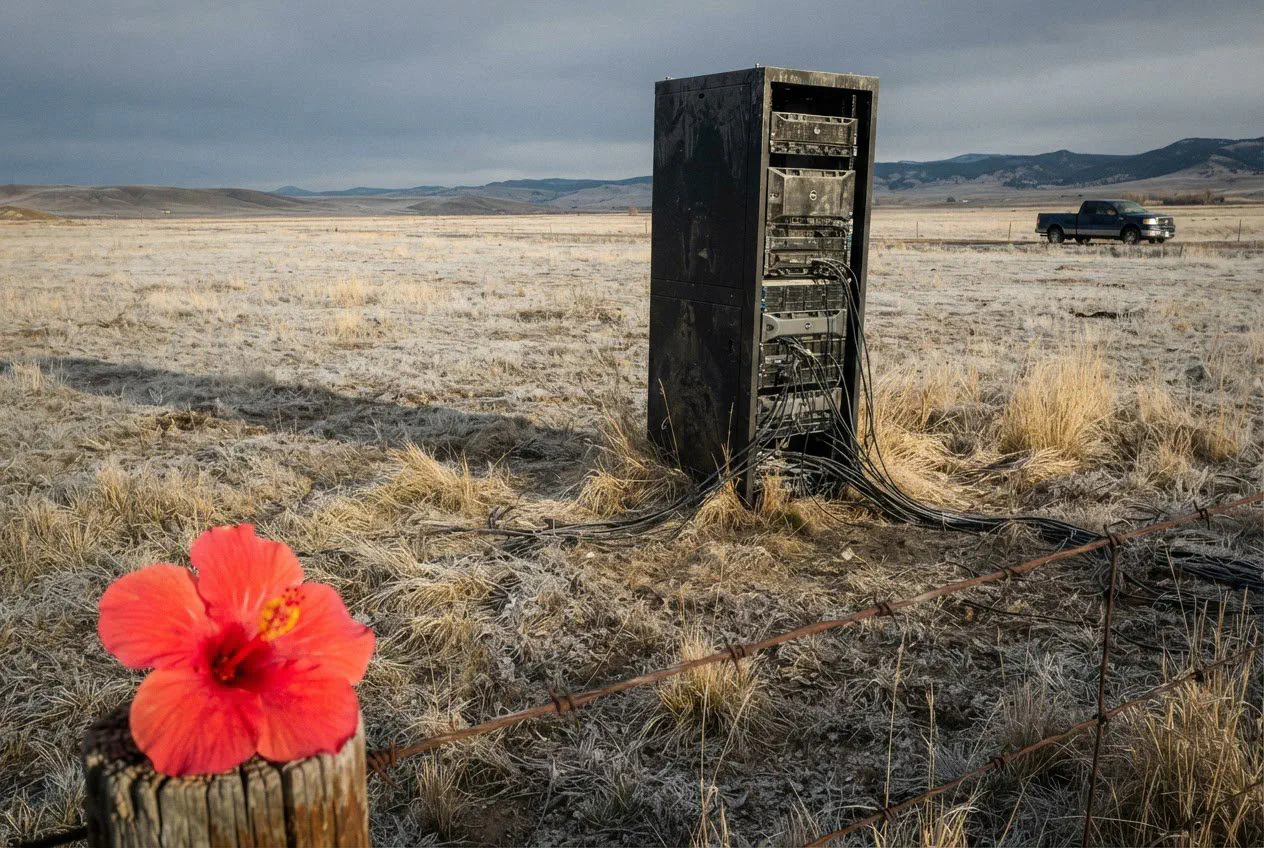
The City Commission recently approved the “Open Range Computational Initiative,” a policy allowing massive server farms to relocate from climate-controlled facilities to the open pastures near Four Corners. Under the new act, data centers are classified as “non-mobile livestock,” granting them the same rights to public land as a wandering herd of cattle.
Proponents of the measure suggest that keeping servers in the valley’s natural, fluctuating climate will save millions in cooling costs. By simply opening a few vents and letting the brisk Bridger breeze circulate through the racks, the machines can maintain optimal operating temperatures without the need for synthetic air conditioning.
“It’s really about synergy,” explained Arthur Pringle, a local developer who recently converted his hay shed into a Tier IV data facility. “My servers are currently processing 40,000 transactions per second, and they seem much happier now that they’re shielded by a stand of cottonwood trees. Plus, the stray elk that wander through the rows provide a sort of calming, organic aesthetic that you just can’t replicate in a windowless warehouse.”
Critics, however, remain concerned about the potential for digital overgrazing. The concern is that as these arrays multiply, they may consume the available bandwidth meant for human residents who are just trying to check their weather apps. Others worry about the “data runoff,” where excess bits of information might leak into the Gallatin River and confuse the local trout populations.
The commission noted that as long as the data centers do not block public access to the M Trail, they are welcome to stay as long as they provide a net benefit to the local economy. For now, the servers are tethered to the power grid with heavy-duty extension cords and are expected to produce their own heat during the upcoming winter months.
So far, the only documented complication involves a persistent group of neighborhood cows that have been attempting to calibrate their internal clocks to the synchronized quartz crystals within the mainframes. The machines are currently operating at a steady hum that matches the frequency of a distant wind turbine.
Inspired by real local coverage. No actual journalism was harmed in the making of this article.